

The Path That Once Worked
How small cracks form when past success hardens into certainty.


You probably allow past decisions to shape your present and future actions.
“That’s how things have always been done,” you probably think. “I’ve come this far – I can’t change now,” you might stress.
It’s a classic sunk-cost fallacy – an investment in a path toward a goal we refuse to abandon, even as warning signals begin to appear. But don’t fret; no one’s immune to it. It’s the first crack that forms in every system.
This behaviour is especially prevalent in any system where past success dictates present and future innovations.
In this post, I explore path fixation as the tendency to confuse commitment with progress, sticking to familiar paths even after the conditions that initially created value have changed.
The Fixed Mindset
Phrases like “That’s how we’ve always done things” are entrenched in any culture, from business to politics. They embody an uncomfortable behaviour that incites troubling problems: path fixation.
In many organisations, teams lock onto familiar methods, inherited frameworks, past success stories, or dominant “This is how it’s done” narratives. In other words, it’s a fixed mindset that turns a path into a goal itself – rather than a means to an end.
Path fixation isn’t limited to organisations; it shows up in everyday life. We convince ourselves we’re driving the fastest route, we can read without our glasses, and we can build the shed single-handedly.
(When I say “we”, I mostly mean myself – though I like to believe I’m not alone.)
In each case, we think we’re so damn right in our methods that we’ll persist in repeating them regardless of the consequences.
The point is, these behaviours emerge when we become overconfident in our abilities, overly reliant on what worked before, or, occasionally, just plain lazy.
Path fixation can lead to more serious consequences in organisations. What begins as confidence in a winning approach hardens into commitment to a single path – even as conditions change. Over time, familiarity is mistaken for progress.
The Optimisation Trap
Many organisations believe they’re making meaningful progress when they operate under Agile methodologies such as MVP and Lean. In reality, they often just learn to move faster down the same narrow path.
Teams ship smaller increments, run more experiments, and chase a so-called North Star that slowly pulls them into circles. They rarely pause to ask whether they’re solving the right problem.
Without questioning whether you are solving the right problem, you risk mistaking optimisation for progress – and quietly limiting the value you're capable of creating.
I’m not criticising Agile, Lean, or MVP thinking itself. The problem is that they’re misused: to validate assumptions built on guesswork, and to measure success through short-term movement rather than long-term relevance.
When rapid delivery and continuous optimisation replace exploration, teams risk path fixation. Decisions become reactive, learning slows, and momentum overtakes clear direction.
Path fixation rarely feels wrong at first – it feels efficient, almost intuitive, not unlike what some now call “vibe coding.” The danger lies in the delay between the decisions and the consequences.
The Death Spiral
Path fixation creates a self-reinforcing loop where a system responds to pressure by doubling down on the very behaviours that once led to success. These changes aren’t obvious at first, but they ultimately lead to a downward “death spiral.”
Committing to the same optimisation path that delivers reliable short-term wins can feel logical. Yet over the long term, that same path often collapses under its own weight.
Product teams fall into this trap more often than they realise. They react to problems as they arise and use optimisation as the default response. A familiar pattern is the repeated use of A/B testing – not as a learning tool, but as a way to squeeze results from the same narrow set of variables.
A useful analogy here is a person walking drunk on the sidewalk, swaying left and right. Optimisation without meaning is kind of the same thing.1
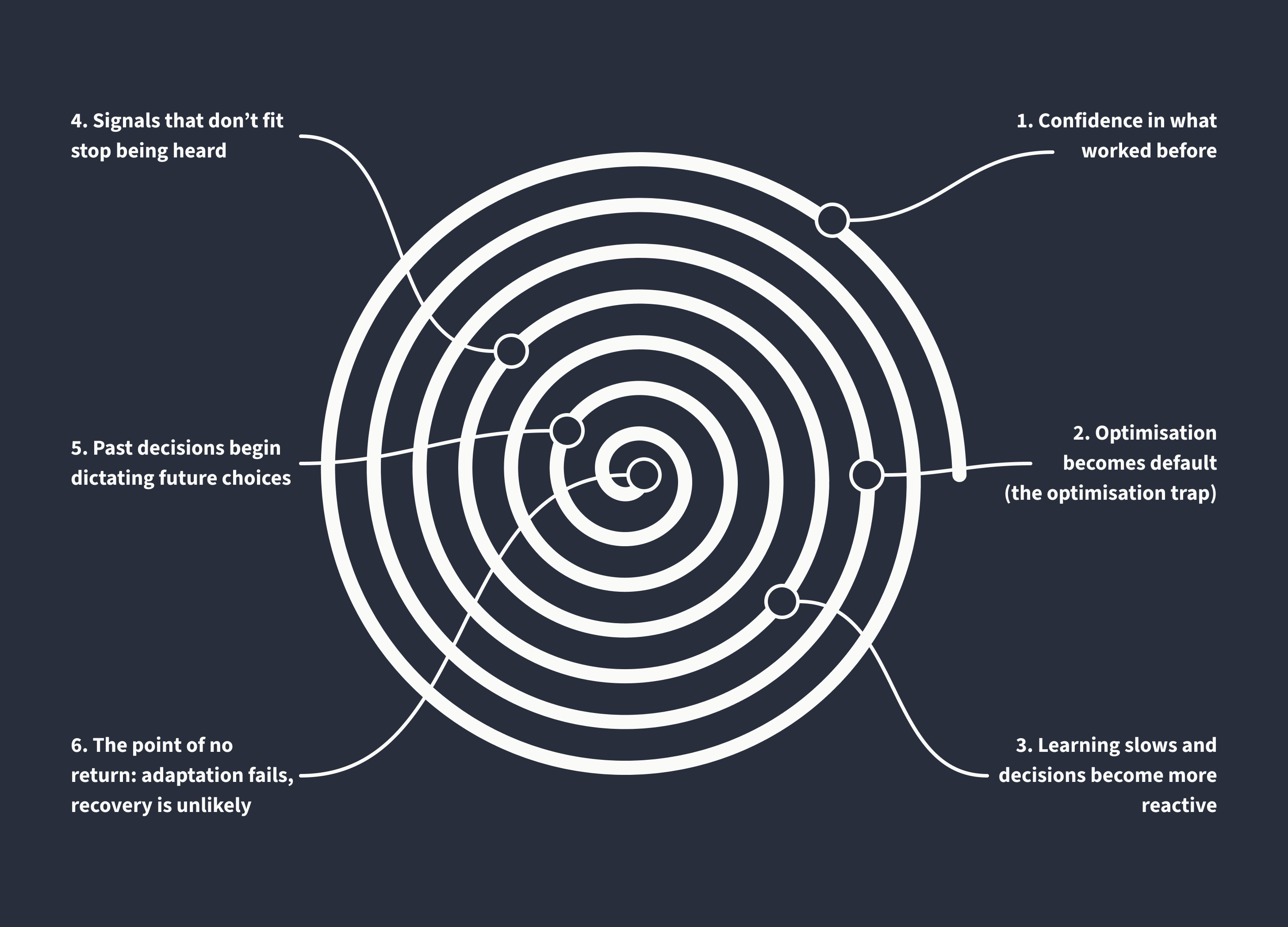
As teams react more, they explore less. They effectively replace curiosity with caution, avoiding the unknown terrain of hidden risks and opportunities. This focus on quantitative metrics overshadows meaningful insights and narrows options in the pursuit of certainty.
This death spiral pattern develops gradually through repeated familiar decisions, making them hard to detect because they seem so ordinary – much like the boiling frog syndrome.
If left unchecked, this same pattern doesn’t just stall teams or products – it scales. No one is immune – not even the most admired brands.
Familiar Paths
Path fixation holds even among the world’s largest brands. Apple, for instance, have been stuck in Groundhog Day for years, with constant “same-shirt” iPhone releases.
Meta’s chief executive, Mark Zuckerberg, hinted at Apple’s stagnation, remarking that “Steve Jobs invented the iPhone, and now they’re just kind of sitting on it 20 years later.”2
While Apple is hardly short of ideas, its focus appears to be weighted more towards optimisation than towards exploring alternative paths – a common tendency among organisations operating at scale. It treads more cautiously than it did during the Steve Jobs era.
Repeating the same strategy may deliver short-term returns, but without exploring new paths, it risks becoming a dead end. It’s like endlessly pruning and shaping the same plant, but if we never plant new seeds, the garden won’t grow.
Exploring more paths increases risk, but fixating on a single one is often riskier still.
Apple illustrates a broader issue: path fixation. This behaviour is often cultural rather than technical, manifesting as bottlenecks, feature factories, rigid roadmaps, and narrow business models – especially in product development.
In response, many organisations don’t challenge the path itself. Instead, they focus on moving faster along it.
But path fixation doesn’t just limit where we’re willing to go – it also distorts how we judge whether we’re making progress at all. And the cost can be fatal.
When Fixation Turns Fatal
Sometimes the cost of path fixation is trivial and easily recoverable. Other times, the consequences are irreversible.
BlackBerry was once a leader in the smartphone market. If cofounder Mike Lazaridis had rethought his strategy, the company could have adapted to the shift from physical QWERTY keyboards to touchscreens. Instead, it locked into a path that no longer aligned with market reality.3
Market share was the price BlackBerry paid for its commitment to a single path. Yet the greatest costs of path fixation are measured in human lives.
The Tragic Cost of Goal Pursuit
In 1986, NASA’s Space Shuttle Challenger exploded just 73 seconds after launch, killing all seven crew members. Investigations revealed that engineers had serious safety concerns, but leadership opted to proceed with the launch under pressure to maintain the schedule.4
Leadership’s refusal to delay ultimately proved fatal.
The Mount Everest disaster of 1996 tells a similar story. Eight climbers lost their lives after continuing their ascent despite clear signals to turn back. As with Challenger, the tragedy was not caused by a lack of skill, intelligence, or experience, but by fixation on a narrow goal.
Management professor Dr Christopher Kayes describes this behaviour as goalodicy: a condition in which individuals and organisations invest more effort in achieving a goal than in learning. When performance overtakes learning, goals can become destructive.5
Doubling Down on Rigid Logic
Path fixation also echoes earlier psychological and organisational concepts – from unhealthy attachment, to path dependency, to what we now casually call tunnel vision.
People often lock onto a single path due to fear, belief, pressure, or habit. This tunnel vision narrows their field of view, obscuring safer or more effective alternatives even as warning signs appear. While emotion plays a role, path fixation is rarely irrational. It is often carefully justified.
BlackBerry’s leadership rationalised its strategy. NASA’s management convinced itself that launch conditions were acceptable. Everest expedition leaders insisted that climbers wait for instructions.
These behaviours reflect a conventional leadership – one rooted in authority, control, and command – where leaders tell others what to do rather than helping them learn how to adapt.
When leaders fail to listen, acknowledge doubt, or include alternative perspectives, path fixation hardens into a path towards destruction.
Across domains – from technology to mountaineering – people often follow leaders. But when leaders fixate on a single vision, they pull their followers down the same narrowing path – usually silencing doubt, suppressing feedback, and mistaking obedience for alignment.
The danger lies not only in ignoring vital information, but in the quiet confidence that this path must be right – even as evidence mounts to the contrary and decisions begin to affect millions of lives.
The Great Leap Forward: Path Fixation at Scale
Between 1958 and 1962, China experienced the largest man-made famine in recorded history. Known as the Great Leap Forward, it resulted in an estimated 30–55 million deaths. While often taught as a historical tragedy, it also illustrates the cost of extreme, civilisation-wide path fixation.
It began with a revolutionary: Mao Zedong.
The Subtle Replacement and the Four Pests Campaign
Agriculture was one of the first casualties. Mao abolished private farming and replaced it with vast communal systems that removed local ownership, incentives, and accountability. In effect, Mao bulldozed China’s agricultural foundations.
Mao also turned China into a nationwide steel experiment, ordering millions of peasants to leave their fields and build backyard furnaces to melt down tools and equipment. It was a mandatory obligation tied to an industrial movement and ideology, rather than an act of innovation.
So far, Mao managed to replace private and sustainable farming with an industrial project. The most infamous failure followed soon after.
In an effort to protect crops, Mao launched the Four Pests Campaign, ordering the extermination of rats, flies, mosquitoes – and even sparrows. Labelled as the “enemies of the people,” the mobilisation turned an entire civilisation into a pest-control task force.
Peasants banged pots and pans to keep sparrows airborne until they dropped dead from exhaustion. Nests were destroyed, eggs smashed, and killing quotas set. Within weeks, millions of birds were exterminated. The skies fell silent. Victory was declared.
But then, disaster struck.
Doubling Down on the Death Spiral
It later transpired that the sparrows had been eating the insects.
With their natural predator gone, insect populations surged, leading to locusts and other pests devouring crops on a massive scale. In trying to eliminate a perceived problem, Mao’s campaign destroyed a critical ecological balance. The peasants were left without food.
At this point, Mao had a choice: learn, adapt, and change course – or double down. He chose the latter.
Still convinced his ideology was sound, Mao turned to Soviet-backed agricultural thinking that dismissed genetics as bourgeois nonsense. That belief filtered down through policy and instruction, encouraging peasants to believe that enthusiasm and effort could overcome biology itself.
As the peasants ploughed deeper and planted closer, they damaged the roots and suffocated the crops. In trying to repair one broken system, another quietly collapsed alongside it.
Mao refused to listen. He silenced dissent, leading to fear among bureaucrats who inflated harvest figures and local leaders who hid the truth. As grain stockpiles dwindled, exports were made to project an image of socialist success, while rural populations faced starvation.
Mao led millions – like a political Pied Piper – down a death spiral toward one of the deadliest famines in human history.
The Great Leap Forward serves as a haunting reminder of the dangers of leaders who ignore alternative perspectives and suppress learning. When adaptation is viewed as disloyalty, a singular approach can create an illusion of control and ultimately lead to self-destruction.6
When the Path Becomes the Problem
From Apple’s stagnation to the Great Leap Forward, these examples show how failing to pause and reassess our path can lead to consequences ranging from trivial to irreversible – especially when efficiency and momentum replace learning.
Path fixation is a behaviour driven by emotion and rigid logic. It places individuals and organisations on a seemingly correct path while defying reality. This tendency thrives in environments that reward predictability and view deviation as risky, even as the chosen path itself decays.
When learning slows, and signals are ignored, value doesn’t disappear instantly; it quietly dissipates long before anyone calls it failure.
Most dangerously, path fixation happens when we cling to what once worked, mistake signals for real value, and fail to connect action, meaning, and consequence.
Path fixation isn’t simply stubbornness. It is fear disguised as certainty. As Rita Mae Brown famously observed (often misattributed to Albert Einstein): “Insanity is doing the same thing over and over again and expecting different results.”
How Path Fixation Shows Up
Path fixation isn’t about choosing the wrong path; it’s about sticking to the right one for too long, even when conditions change. We’ve seen it in leaders like Mao, climbers on Mount Everest, and decisions at NASA, and it still shows up today in product teams and the world’s biggest brands.
To summarise everything we’ve discussed – or if you’re looking for a TL;DR – I’ve condensed the key points below.
1. We stick to one route because it feels familiar.
A single idea, product, or strategy becomes the “how things are done” mantra. It feels safe and justified, even as we stop noticing how the world around us is changing.
2. Performance starts to matter more than learning.
Pressure builds – from targets, timelines, reputation, or authority. Instead of questioning what we’re doing, we defend past decisions and avoid uncomfortable truths.
3. We stop listening to what challenges the current path.
New signals – risks, opportunities, or alternative perspectives – are brushed aside because they challenge the current path. The feedback loop quietly closes.
4. The past begins to decide the present.
Earlier choices, whether they worked or not, shape what feels possible now. Over time, staying on a once-successful path narrows the range of options, even if no one consciously chose to limit it.
5. Adaptation slowly fades.
Learning slows, minor errors stack up, and innovation plateaus. The system doesn’t fail all at once – it simply becomes less able to change course when it needs to most.
Reorienting the Journey
Every journey requires reorientation. Even if we don’t abandon our paths entirely, we must explore the terrain around them – to discover alternatives, adapt to changing conditions, and remain open to learning.
But what happens when the signals we trust aren’t clear at all, but an illusion? That is where the next behaviour begins.
Something to think about: Where have you seen a path that once worked start to crack? What signals were easy to ignore – and how did you respond when they appeared? Feel free to share your thoughts in the comments 👇
Sidewalk Anology: Debbie Levitt, Customers Know You Suck
Mark Zuckerberg quote: Outlook Business, “Has Apple Lost Its Edge? Mark Zuckerberg Slams ‘Stagnant Innovation’ in iPhones, Other Accessories”
BlackBerry: Adam Grant, Hidden Potential
NASA Challenger: Adam Grant, Hidden Potential
Mount Everest Disaster, Goalodicy: D. Christopher Kayes, Destructive Goal Pursuit
The Great Leap Forward: Archaeo Histories | Wikipedia