

Questioning the Paradigm
Why the deepest leverage points are often hidden within our paradigms.


In the late 1990s, after years of modest performances at the Olympic Games, British Cycling faced a profound question: what meaningful innovation could make change possible?
Groundbreaking technology, equipment, or talent alone could not guarantee more medals. British Cycling needed a different way of thinking about performance itself.
Rather than searching for a single breakthrough, British Cycling began treating performance as a system of many interconnected parts. Over time, this philosophy helped transform the organisation into one of the most successful sporting programmes in modern history.
In many ways, the philosophy became a paradigm in its own right.
In this post, we'll explore paradigms as the highest leverage point. They shape how people understand, reinforce, and navigate systems – and, in turn, the systems themselves.
The Story of Marginal Gains
British Cycling’s golden era began around the early 2000s. From Beijing to Rio, cycling heroes Chris Hoy, Bradley Wiggins, Victoria Pendleton, and the Kenny duo dominated Olympic track and road cycling.
Yet those gold-medal victories did not emerge from the athletes alone.
Behind them sat a wider system of coaches, funding, technology, facilities, institutions, and culture. Together, they helped sustain elite performance over time.
But Britain wasn’t always a dominant cycling nation. Between 1976 and 2000, British Cycling struggled to achieve consistent success on the world stage. However, a turning point came in 2003 when Sir Dave Brailsford became Performance Director of British Cycling.
Rather than searching for a single breakthrough, Brailsford introduced a different way of thinking about performance. Drawing on physiology, coaching, and data, he focused on the many interconnected factors that influence results.
These improvements went far beyond racing itself. Small changes across many areas, from psychology to team coordination, came together in a philosophy known as the aggregation of marginal gains.1
The benefits became especially visible during the 2008 Beijing Olympics. British cyclists won eight gold medals, topped the cycling medal table, and smashed world records.
More importantly, the philosophy shifted attention towards where change was possible. Every part became a potential opportunity for improvement. Even sleep became a variable.
Thinking about optimisation this way, we can begin to see where opportunities for change exist. Systems thinkers call these leverage points.
Points of Power
Systems thinker Donella Meadows described leverage points as “places within a complex system where a small shift in one thing can produce big changes in everything.”2
Importantly, not all leverage points are equal, nor do they need to be applied at once. Rather, they help us understand where and how change becomes possible.
Strategic adjustment is the key idea. Effective intervention is not always about disruption or replacement. Often, leverage arises through careful adjustment of an existing system – not too much, not too little.
Brailsford, for example, did not introduce a single revolutionary technology to British Cycling. Instead, he improved many interconnected parts within an existing system that already had the necessary structure, people, and capabilities.
But not every adjustment guarantees success. Changes can lead to delayed or unintended outcomes, emphasising the need to understand cause and effect within a system. Delays can be especially deceptive, causing people to mistake early signals for reliable patterns.
This is why Peter Senge’s famous phrase – “Take two aspirin and wait” – matters. Sometimes the most effective intervention is not another immediate reaction, but allowing enough time for the system to respond, stabilise, and reveal its wider patterns.
Once those patterns become visible, the next question becomes where change is most effective.
Meadows spent much of her work exploring that question. Her answer came in the form of a hierarchy of twelve leverage points. She identified twelve in total, ranging from physical structures to beliefs, worldviews, and paradigms.
Let’s briefly unpack them, following Meadows’ order of effectiveness.
12. Numbers
Adjusting parameters such as budgets, taxes, quotas, or targets can influence a system, but they rarely change its overall behaviour. You can’t run an economy simply by moving numbers around.
11. Buffers
Buffers help absorb shocks and stabilise flows. However, too much buffering can reduce flexibility and responsiveness. Excess inventory, for example, can tie up resources, create waste, and increase risk.
10. Stock-and-Flow Structures
Physical structures are powerful but difficult to change. Once roads, factories, or rail networks are built, the challenge is usually to understand their constraints and bottlenecks rather than redesign them.
9. Delays
Delays are among the most deceptive aspects of systems. When results take time to appear, people often mistake temporary signals for lasting patterns and overcorrect in response. Sometimes the most effective intervention is not acting faster, but slowing the rate of change itself.
8. Balancing Feedback Loops
Balancing feedback loops helps stabilise systems. Whether it’s slowing spending or monitoring an electricity meter, leverage comes from responding to important signals before instability emerges.
7. Reinforcing Feedback Loops
Reinforcing loops amplify whatever direction a system is already moving. They can accelerate growth, learning, and innovation, but also escalation and collapse. Understanding when reinforcement becomes excessive – causing people to double down on a failing path – is often a critical leverage point.
6. Information Flows
Meadows argues that restoring missing information is often a cheaper and more effective intervention than rebuilding physical infrastructure. Simply displaying household energy use, for example, can encourage people to reduce consumption.
Yet visibility alone is not enough. Leverage often comes from identifying and acting on the signals that matter most.
5. Rules
Rules define boundaries, incentives, permissions, and constraints, ultimately shaping behaviour. As Meadows observes, “Power over the rules is real power.” Those who shape the rules often shape the system itself. Change the rules, and behaviour often changes with them.
4. Self-Organisation
Self-organisation describes a system’s ability to evolve its own structure and behaviour. Biology provides a clear example. Through adaptation, learning, and feedback, living systems continually reorganise themselves in response to changing conditions, often without central control.
3. Goals
Goals shape the direction of an entire system. Resources, behaviours, priorities, and decisions gradually align around them. As a result, changing a goal often changes the behaviour of the wider system.
A company focused on quarterly profits, for example, will often behave very differently from one focused on long-term resilience.
2. Paradigms
Meadows describes paradigms as “the sources of systems.” They are the assumptions, beliefs, and worldviews that shape how people interpret reality itself. Because paradigms influence meaning, institutions, incentives, and behaviour, they are extraordinarily difficult to change.
Marginal gains, for example, reflected a paradigm that saw performance as a system rather than a collection of isolated factors.
1. Transcending Paradigms
Meadows’ highest leverage point involves recognising that no paradigm represents absolute truth. Rather than becoming trapped within a single worldview, people gain the ability to consider alternative interpretations, systems, and possibilities.
Seen this way, transcending paradigms represents the deepest form of systems learning. It expands our capacity to reinterpret not only systems, but the world itself.
Importantly, Meadows notes that the higher the leverage point, the more resistant systems become to change. Adjusting numbers may be relatively easy. Yet challenging goals, assumptions, or paradigms often require collective shifts in behaviour, culture, and understanding.
This helps explain why paradigms matter so much. Systems are shaped not only by structures, incentives, and rules, but also by the beliefs, narratives, assumptions, and interpretations people collectively carry within them.
If paradigms are so influential, an important question follows: how do they become embedded in the first place?
How Paradigms Become Embedded
Paradigms rarely stay as abstract ideas. Over time, they spread through institutions, professions, cultures, communities, and everyday practices. This is what makes paradigms especially intriguing.
As people repeatedly act on the same assumptions, those assumptions become woven into behaviours, incentives, routines, and expectations.
But the deeper paradigms become embedded, the harder they are to see. They then shape how people interpret problems, define value, coordinate behaviour, and decide what appears normal, rational, or true.
We can observe this in everyday working life. A workplace that rewards high productivity may normalise long hours, quick responses, and overtime. As employees adopt these behaviours to succeed, they reinforce the belief that productivity is the primary measure of progress.
Many of us have experienced the awkward feeling of leaving work on time while the rest of the team works late to meet a deadline. Over time, these behaviours become accepted as normal simply because the surrounding system continually reinforces them.
Seen this way, paradigms do not simply influence systems from above. They become embedded within the very structures, behaviours, and relationships that sustain them.
From Shared Assumptions to Belief Systems
Looking across product, design, innovation, and institutions, I’ve noticed how difficult it can be to think beyond established paradigms.
Most people do not wake up consciously believing in a particular framework or worldview. Paradigms typically emerge gradually as behaviours, assumptions, and practices become accepted over time.
For example, interns or junior professionals inherit ideas from academia, mentors, and workplace culture. Organisations then reinforce them through incentives, goals, and everyday practice.
Over time, what began as a practical way of doing things can become accepted as the way things should work.
Simply put, people align around what feels normal, effective, and familiar. As these shared assumptions become embedded in everyday behaviour, they can begin functioning much like belief systems.
Here, belief does not necessarily imply ideology or religion. Rather, it describes systems of shared meaning built on values, assumptions, incentives, norms, and interpretations.
The key question is how shared meanings enable large groups to coordinate in the first place.
In Sapiens, Yuval Noah Harari argues that large groups of people cooperate through what he calls “intersubjective realities”. These are shared stories and interpretations that help people coordinate at scale.3
“Like money, limited liability companies and human rights, nations and consumer tribes are intersubjective realities,” Harari writes.
Like Harari’s intersubjective realities, paradigms can function much like belief systems. They provide shared assumptions about how the world works, what matters, and how people should behave.
Harari’s broader point is that large-scale human systems persist because they coordinate around shared meaning. Paradigms, therefore, are not merely abstract ideas – they are mechanisms that help people coordinate, cooperate, and organise collective action.
Drawing from Harari’s examples, these systems can include money, laws, nations, and corporations. They can also appear in everyday rituals, like pretending to enjoy a networking event because everyone else seems to.
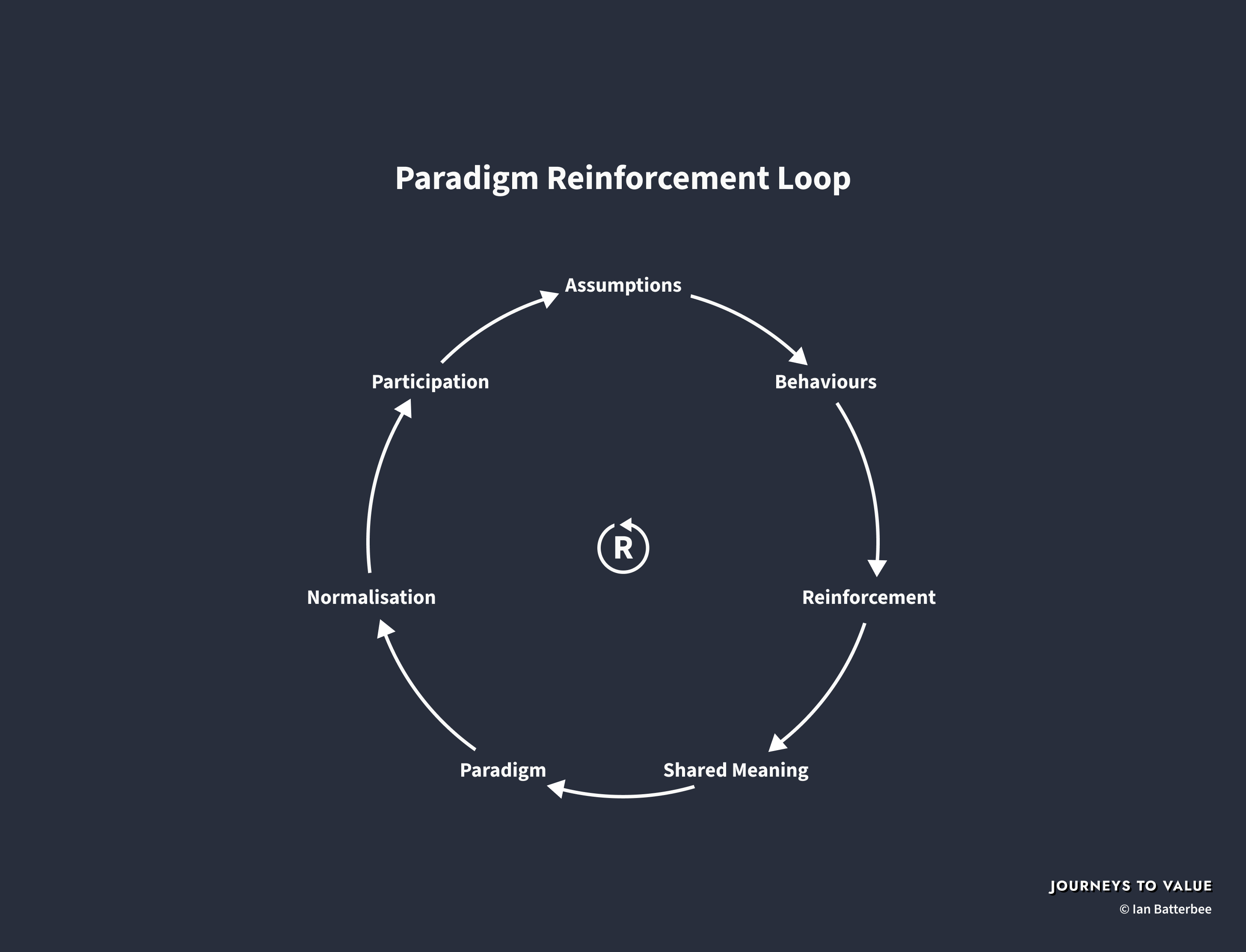
Over time, they become so deeply woven into institutions, culture, and behaviour that they feel normal, unquestionable, and often invisible.
When Paradigms Feel Natural
Within organisations, people may unknowingly align around behaviours, targets, frameworks, or metrics that gradually come to feel objective and unquestionable.
Over time, these patterns become reinforced through performance reviews, incentives, governance structures, and even professional identity.
We can observe similar patterns throughout everyday life. Families, schools, communities, and wider society all reinforce shared expectations about behaviour, success, belonging, and status.
Whether we consciously believe in social, cultural, political, corporate, or religious systems or not, we still participate in many of them intuitively.
In doing so, we reinforce systems of shared meaning – even when we claim not to believe in them directly. Participation itself becomes a form of reinforcement.
The idea of intuition closely mirrors Daniel Kahneman’s System 1 thinking: fast, automatic, and deeply conditioned through repetition.4 Over time, assumptions and norms become so deeply embedded that they fade into the background of everyday life.
That’s when paradigms and belief systems begin to feel natural. Not necessarily because they are objectively true, but because they are continually reinforced and socially coordinated over time.
This concept circles us back to a recurring theme throughout Journeys to Value: Systems provide the structure for repeated behaviour, while human behaviour simultaneously reshapes those very systems.
Yet behaviour is not the only force that reinforces paradigms. Narratives play an important role, too.
Narratives, Identity, and Paradigms
Narratives help carry and reinforce systems of shared meaning. Every group – whether a family, political movement, organisation, or nation – constructs stories about who they are, what they value, and what they seek to achieve. These stories justify, protect, and strengthen what is collectively believed, valued, or pursued.
Whether promoting lifestyles, framing political issues, or reinforcing organisational values, these narratives do more than communicate ideas. They help people coordinate around shared meaning.
Mainstream and independent media also help coordinate shared meaning, often through the lens of underlying paradigms. Two journalists from competing newspapers can report on the same event yet frame it in very different ways.
The facts may remain largely the same, but the interpretation can differ significantly. Readers often gravitate towards the narratives that best align with their existing assumptions, values, and beliefs. Similar dynamics can emerge within organisational thinking.
Organisations often rely on methodologies, frameworks, and operating models to solve problems and coordinate work. These can range from OKRs and KPIs to MVP thinking and Product Management practices.
Initially, these approaches serve a practical purpose. They help teams make decisions, allocate resources, and reduce uncertainty. Over time, however, organisations build narratives around them. Teams begin to identify with the framework and treat it as proof of good practice.
“MVP is our philosophy,” some might say.
“This is how modern Product Management works,” others might insist.
The challenge arises when useful tools become accepted as the only way of working. As a result, repeated success can reinforce shared beliefs, gradually transforming adaptable methods into fixed paradigms.
Once this happens, they become increasingly difficult to question, reinterpret, or evolve. Teams continue operating within familiar patterns, while the framework gradually shapes how they interpret success, value, and progress.
But paradigms do not emerge in isolation. Many of the beliefs that shape organisations are first cultivated by education, industry, government, culture, and society itself.
Organisations, Institutions, and Systemic Reinforcement
While paradigms shape everyday behaviour, wider institutions often shape how organisations think and act.
Educational institutions, professional bodies, governments, regulators, industries, financial systems, and consumers all influence what organisations interpret as rational, valuable, efficient, or legitimate.
In many cases, a company may genuinely believe it is acting rationally. It complies with laws, upholds standards, and meets industry expectations. Yet many of the assumptions guiding those decisions have been inherited from the wider system rather than consciously chosen.
That same system also reinforces competing ideas about success, from growth and performance to ethics, social responsibility, and environmental stewardship. As a result, organisations can become just as shaped by paradigms as the people working within them.
This also helps explain why organisational change is rarely confined to the organisation itself. No matter how hard people push, the wider system will often constrain, resist, or redirect the change they are trying to create.
Customers, investors, regulators, suppliers, competitors, technologies, and social expectations all influence what change is possible. A company prioritising long-term value, for example, may still face pressure from markets, reporting cycles, consumer expectations, or industry norms.
We can now begin to see that paradigms shape far more than belief. They influence how people and organisations interpret signals, define success, reinforce behaviour, and create shared meaning.
Understanding paradigms is one thing. Recognising when they begin to drift is another.
Signals of Paradigm Drift
When we question the paradigms themselves, we begin to see Meadows’ deepest insight. The most powerful leverage points are often not found in the structures we can see, but in the assumptions, interpretations, and shared meanings through which we understand them in the first place.
Yet paradigms do not remain fixed. Over time, they evolve, adapt, and sometimes drift. Shared assumptions become reinforced. Success patterns harden into habits. What once helped people learn and adapt can gradually become difficult to question.
Perhaps the most important shifts are not the ones we immediately notice, but the ones quietly unfolding beneath the surface. Learning to recognise those signals may be one of the most important forms of systems learning.
Recognising when paradigms shift – and how to respond when they do – is where this story will continue next.
Something to think about: What paradigms shape how you interpret success, value, and progress? And how might your everyday behaviours be helping reinforce them in return?
Feel free to share your thoughts in the comments 👇
Discussion of the aggregation of marginal gains draws primarily on Sir Dave Brailsford’s British Cycling performance philosophy, as discussed in interviews, media coverage, and James Clear’s Atomic Habits: An Easy & Proven Way to Build Good Habits & Break Bad Ones
Discussion of leverage points and paradigms is based on Donella H. Meadows' Thinking in Systems: A Primer
Discussion of intersubjective realities, shared meaning, and large-scale human cooperation is based on Yuval Noah Harari's Sapiens: A Brief History of Humankind
Discussion of System 1 thinking and intuitive decision-making is based on Daniel Kahneman's Thinking, Fast and Slow