

Everything is Connected
Systems shape journeys. Journeys reshape systems.


We design for systems. We talk about systems. We think in systems. This extraordinary field, which explores how we connect everything as a whole, has grown in popularity. But its origins stretch back nearly a century.
In the 1930s, biologist Ludwig von Bertalanffy developed general systems theory, which was later expanded by thinkers such as Jay Forrester, Donella H. Meadows, and Peter Senge.
When I first read Thinking in Systems1 by Meadows, it changed how I saw the world. It revealed a pattern I’d always sensed but never articulated. Similarly, The Fifth Discipline by Senge reinforced the idea that organisations often focus on symptoms rather than underlying causes.2
Systems thinking, however, isn’t confined to a single discipline. It applies across contexts, far beyond product and service design. From organisations to communities, systems shape relationships, behaviour, and the patterns that emerge over time.
In this post, we’ll explore systems as dynamic, living entities. We’ll look at how innovation operates as a system that facilitates the journeys toward value. At the same time, we’ll look at how these journeys continuously shape the system in return.
The Brick That Became a System
In 1954, Danish toymaker Godtfred Kirk Christiansen and purchasing manager Troels Petersen made a profound observation about the toy industry.
“What an industry this is – no system of any kind whatsoever!”
At the time, toys were often standalone objects made from wood or metal. Each toy was designed for a specific purpose. You played with it as intended, and when the story ended, so did the play.
But following that conversation with Petersen, Christiansen began to approach toys differently. Instead of creating complete, “cut and dried” toys, he expanded upon an existing idea that had “fired his imagination.”
He noticed something special about a small plastic brick his company was producing. Individually, the bricks were simple. Combined, they became a system.
Today, that system is known as LEGO.
Each LEGO piece is connected through simple rules. But together they create complex structures. Children can build, break, and rebuild endlessly. A house could become a car. A car could become something entirely new. The outcome isn’t predefined; it emerges through play.
What LEGO discovered wasn’t just a new way to design toys. It was a new way to think about creation itself. And what makes LEGO such a powerful system is best described by a LEGO Group employee:
“The LEGO System means that: all elements fit together, can be used in multiple ways, can be built together. This means that bricks bought years ago will fit perfectly with bricks bought in the future… It means that a LEGO element not only has instant value, but will keep its value always… We will always make sure that all bricks – from yesterday, today and tomorrow – fit together.”3
The key takeaway is that LEGO is more than a construction system; it creates long-lasting value. Designers create sets ranging from City to Technic, each offering different forms of play and exploration. Once released, those sets become shared patterns that people repeat, reinterpret, and expand upon through play.
Through participation and reciprocity, new ideas spread across LEGO communities, showing how value resonates outward through interaction.
Beyond LEGO bricks, systems can be found everywhere – either waiting to be realised into something tangible or built from the ground up. Systems hold things together as environments, and each one shapes our journeys toward value.
Systems Are Everywhere
“A system is a set of things – people, cells, molecules, or whatever – interconnected in such a way that they produce their own pattern of behaviour over time.” – Donella H. Meadows.4
Meadows summarises the meaning of a system well. She describes a system as a set of interconnected parts organised through structure and relationships to achieve a goal or serve a particular function or purpose.
Systems exist all around us – and even within us. Your home is a system. Your car is a system. Your body is a system. Your cat is a system.
Everything is made up of interconnected parts working together to produce patterns of behaviour over time. Once you start seeing systems, it becomes difficult to stop.
Products, services, organisations, cities, economies, nations, and cultures are all systems. Booking a doctor’s appointment is part of a system. Even breakfast is part of a system, in which relationships form between equipment, food, energy, and people working toward different outcomes.
But systems can also become dysfunctional when certain parts stop working or disappear altogether. You can’t make coffee without a cup or a working kettle. When one part breaks down, the effects ripple across the wider system.
Seeing the World Differently
Too often, we become trapped in surface-level details and lose sight of the bigger picture, unable to see the wood for the trees. But through a systems thinking lens, we begin to zoom out.
Instead of focusing only on isolated parts, we start to see relationships, dependencies, patterns, and movement across the whole.
Systems thinking reveals how things depend on and influence one another, and how they evolve together over time. More importantly, it helps us identify new paths – each leading toward new opportunities for realising value.
Christiansen used systems thinking, whether consciously or not, to recognise a different kind of possibility in the humble LEGO brick. Without that shift in thinking, the LEGO Group may have continued producing standalone toys rather than interconnected systems of play.
But by understanding the relationships among the pieces, the company opened itself to multiple paths to innovation.
Over time, LEGO expanded into new themes, from fantasy to – my personal favourite – Pirates. Yet those themes still required coordination. New bricks had to remain compatible with existing ones, ensuring compatibility across product generations.
Seen this way, LEGO has maintained a remarkably consistent innovation narrative: the right system enables scalability, flexibility, and adaptability. In doing so, it reveals how separate parts connect into larger patterns of value and behaviour.
But LEGO is only one example. Systems exist in many different forms across the world around us.
Systems Take Many Forms
There are many ways of looking at systems.
Biological: living systems made up of interconnected parts that work together to survive, adapt, and maintain balance.
Ecological: natural environments where organisms, resources, and conditions interact through cycles of growth, decay, regeneration, and balance.
Social: groups of people connected through relationships, shared behaviours, rituals, stories, norms, and repeated interaction over time.
Organisational: structured groups such as businesses, schools, hospitals, and governments that coordinate roles, decisions, services, production, and responsibility.
Functional: mechanical, technical, or operational systems designed to perform tasks, often with repeatable processes and interdependent parts.
Conceptual: abstract systems of thought, belief, meaning, values, assumptions, and ideas that shape how we interpret the world and act within it.
Together, these lenses show that systems go beyond organisations or machines. They can be living, social, structural, functional, or conceptual. What connects them is not their form, but the relationships between their parts – and the patterns of behaviour those relationships produce.
And those relationships rarely exist in isolation.
Nothing Exists in Isolation
One of the core ideas behind general systems theory is that every system exists within a larger, interconnected framework. A solar system, for example, exists within a galaxy, which itself exists within the wider Universe. And beyond that? Well, who knows what a universe contains?
“The Poached Egg“ diagram5 illustrates how systems exist within groups, layers, and hierarchies. A Universe is a larger system that houses many galaxies, which act as subsystems. Meanwhile, a system of interest is simply the particular system we choose to focus our attention on.
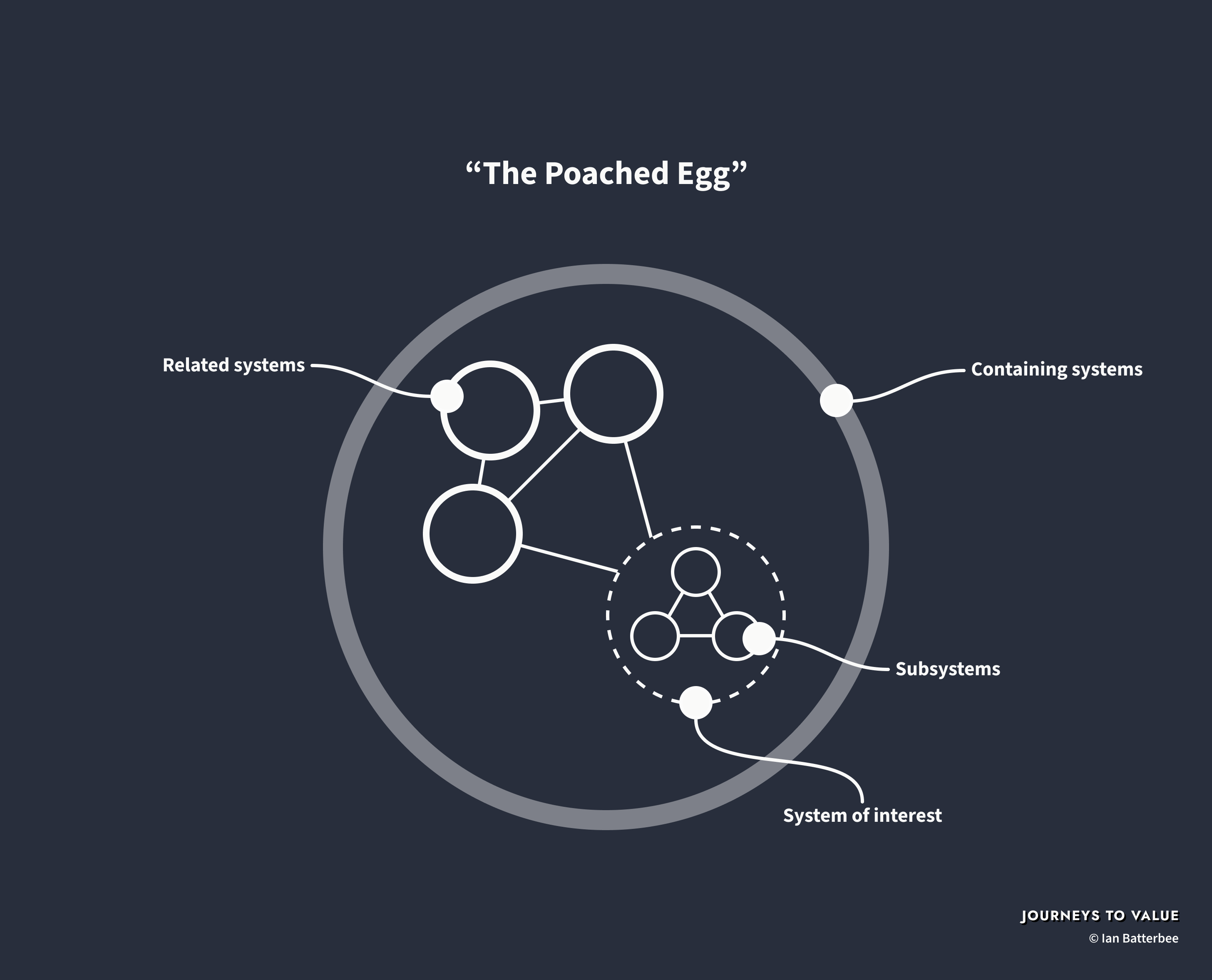
This is often where systems thinking starts giving people headaches. Complexity quickly expands in every direction. But part of systems thinking is learning how to make those relationships easier to understand in practice.
What a System Looks Like
To see this more clearly, let’s break down a booking service as an example. A system forms when multiple entities interact to achieve a shared objective. In this case, a booking system may include:
A website
Notifications
Digital tickets
Payment processing
Customer support
The customer sits at the centre of a booking system comprising interconnected subsystems, such as websites, notifications, payment processing, ticketing, and customer support. Together, these form part of larger organisational, technological, economic, and social systems.
The booking service may be part of a larger travel company. That travel company operates within economic, technological, environmental, and social systems. And those systems, in turn, interact with larger global systems.
Looking Beyond the Surface
The deeper we look, the more interconnected everything becomes. Systems can therefore be understood in many ways. Often, we connect different parts together without even realising we are working with a system.
Systems can become incredibly complicated. Yet their value lies in helping us see the interconnected parts shaping a machine, a hospital service, or even human behaviour itself.
In innovation, systems thinking helps us understand journeys not as isolated steps, but as dynamic patterns of causes, effects, feedback, and interaction.
A map may show the static structure of roads and destinations. Still, a systems lens reveals the relationships, movements, and feedback loops flowing through them. And this is where systems begin to move beyond structure alone. They start to influence behaviour itself.
Systems Shape Journeys. Journeys Shape Systems
We can now begin to understand systems as structure and journeys as movement. Systems hold elements together. Journeys, on the other hand, describe how those elements change, interact, and evolve over time.
A system without movement becomes static – like a forest with no life. But a journey without structure becomes chaotic and ungrounded – a living forest growing wildly beyond control.
Together, systems and journeys form a dynamic relationship that gives rise to behaviour. Systems create the conditions for movement, while journeys continuously reshape those conditions.
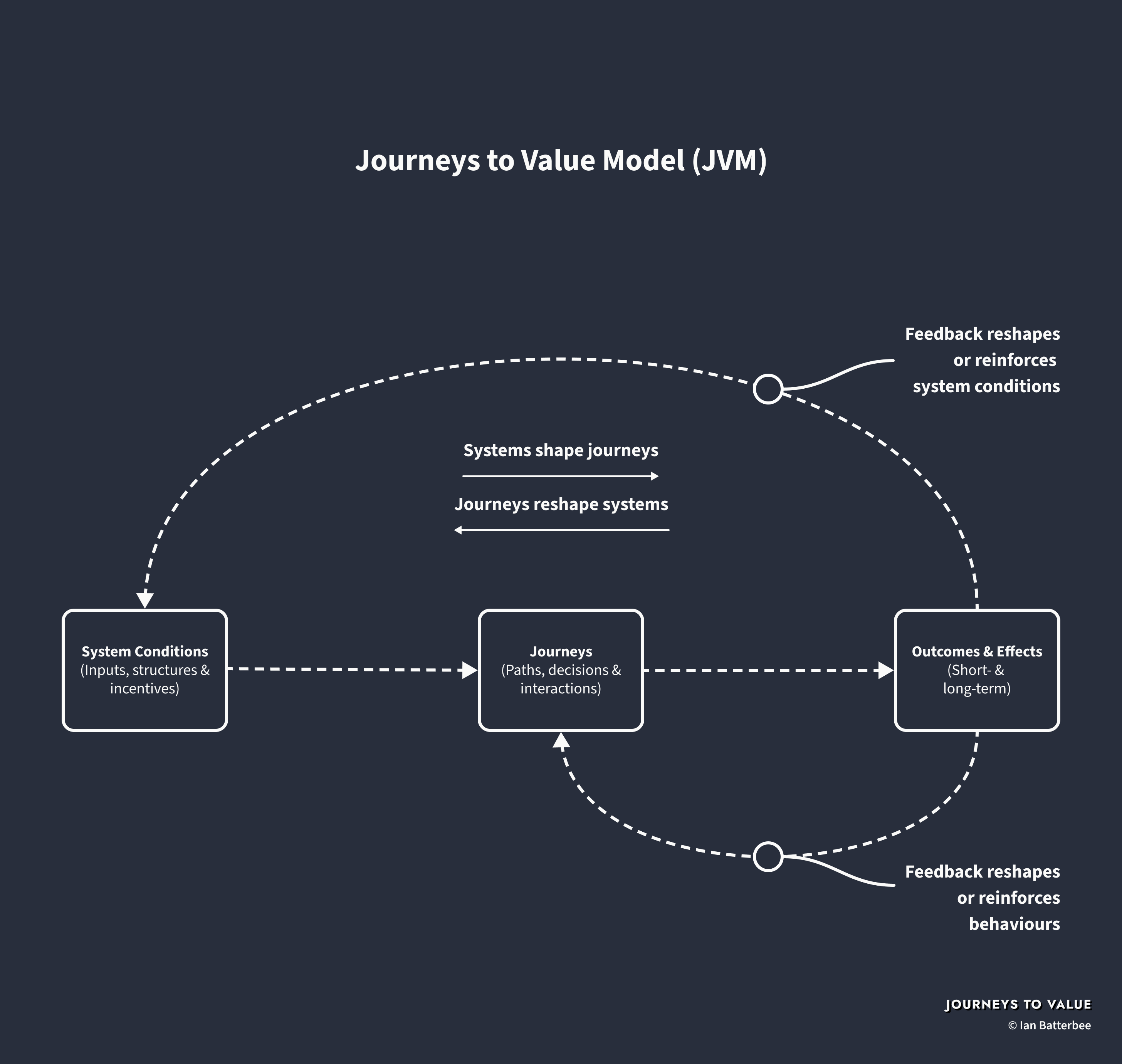
We can visualise the relationship between systems and journeys through the Journeys to Value Model (JVM). Systems create the conditions that shape journeys through structures, incentives, constraints, and interactions. As people move through those journeys, they produce outcomes and effects that generate feedback across the wider system.
Over time, that feedback can reshape both system conditions and behaviour, creating recurring patterns across organisations, communities, and everyday life. The JVM shows how systems influence movement and behaviour, while participation and experience reshape those systems in return – something LEGO demonstrates particularly well.
A System in Motion
LEGO inspires endless adventures through a system of play. Each journey tells a story of structure, arrangement, experimentation, and imagination. A pirate ship doesn’t have to sail across a carpet ocean; it can become a flying machine, a fortress, or a shipwreck island.
And every new journey created has the potential to challenge or expand the conditions set by the system.
When interacting with a LEGO set, people are effectively moving through journeys – making decisions, interpreting signals, coordinating with others, and experimenting through play.
In doing so, they generate feedback. Ideas are tested, adapted, and reshaped over time as people rebuild, repurpose, and recombine pieces into new possibilities.
When Systems Drift
Not every LEGO journey goes to plan, but most failed builds can simply be broken apart and rebuilt. Outside of play, however, misinterpretation and drift can become far more costly. That is exactly what happened when the LEGO Group came close to bankruptcy in the early 2000s.
Between 2003 and 2004, the company faced a severe financial crisis driven by over-diversification away from its core brick products, rising production costs, and debts reportedly exceeding $800 million.
In many ways, the company appeared to misread signals as it rapidly expanded. Over time, this led to structural drift and a shift away from its original purpose. The journeys within the organisation didn’t stop – they simply began heading in the wrong direction.
LEGO’s near collapse wasn’t caused by the system or the journeys alone. It emerged through the tension between the two. The company’s structures enabled expansion, while its innovation journeys pushed the organisation further away from coherence and sustainability.
Simply put: The system shaped the journeys, and the journeys reshaped the system in return.
LEGO avoided collapse by streamlining its product lines, selling off non-core businesses such as theme parks, and refocusing on profitable partnerships, like Star Wars. In doing so, it staged one of the most remarkable turnarounds in modern corporate history.6
Learning Through Adaptation
Looking across LEGO’s colourful history, we can see how systems thinking not only helped establish one of the world’s most-loved toy brands but also helped save it from catastrophe.
No matter how successful a company becomes, it must continue to learn and adapt. Because nothing truly stands still.
Ultimately, systems come alive through journeys. But those journeys also shape behaviour over time, influencing what becomes normal, what is repeated, what is rewarded, and what is ignored.
How Systems Shape Behaviour
Behaviours such as path fixation (staying on the same path too long), value mirage (mistaking signals for value), and story gap (disconnects between narratives and reality) emerge gradually through reinforcement, feedback, and systemic conditions.
But systems play an important role in shaping what behaviour becomes normal, rewarded, repeated, or suppressed – regardless of whether that behaviour is ultimately right or wrong.
A clear example of repeated and accepted behaviour can be found in desire paths.
Following the Worn Path
Desire paths are unplanned trails created by pedestrians or cyclists taking the route they perceive as the most direct or efficient between two points.
You’ll often see desire paths as dirt tracks cutting across grassy areas, parks, or even crop fields. They reveal how original designs frequently fail to match actual human behaviour and needs. But there is another layer to this interpretation.

When a behaviour – like walking a particular shortcut – is repeated enough times, it begins to feel like the expected behaviour. The worn path eventually starts to look like the “right” path.7
Desire paths don’t just reflect preference, but they also reflect acceptance through repetition. Some people follow these routes out of convenience. But others follow simply because the path already appears normal, proven, or socially validated.
Over time, repeated behaviour becomes reinforced through the system itself. What starts as convenience can gradually become accepted as the normal or “correct” path.
This lesson is important for product and service teams analysing user journeys. If users frequently take a certain path, it doesn’t mean it’s well-designed; it may indicate friction, confusion, or attempts to bypass usability issues or bugs.
In other words, repeated behaviour does not always reveal what people truly want. Sometimes it reveals the conditions they have adapted to.
But the way we interpret those behaviours often exposes another problem entirely: how easily we confuse correlation with causation.
Looking Beyond Blame
When things go wrong, people naturally lean toward blame. We blame poor decisions, bad leadership, or a lack of discipline. But systems thinking asks a different question: What conditions made that behaviour more likely in the first place?
In The Fifth Discipline, Senge argues that organisations struggle to learn because they suffer from various “learning disabilities.” One of them – “The Enemy Is Out There” – describes the tendency to blame external people or forces when problems emerge.
Senge suggests this behaviour stems partly from another learning disability: “I Am My Position.” People become so focused on their specific role, responsibility, or boundary that they fail to see how their actions influence the wider system.
In other words, it becomes the familiar: “It’s them, not us.”
We hear this constantly in politics when current problems are blamed on previous governments. As Senge explains, “the enemy out there” is usually an incomplete story. If we focus only on what appears external, we rarely notice the deeper structural conditions operating internally.8
And those structural conditions often shape behaviour far more than we realise.
How Drift Becomes Normal
Systems regulate behaviour through incentives, constraints, feedback, visibility, and reward. Social media platforms make this especially visible. They shape what people pay attention to, what gets amplified, what gets ignored, and how behaviour becomes reinforced over time.
Much of this regulation occurs quietly, often outside conscious awareness.
Over time, behaviours become normalised not because they are necessarily effective or healthy, but because the system continually reinforces them.
It becomes normal to ignore the designated path because convenience feels rewarding. It becomes normal to endlessly scroll, like, and engage because algorithms respond with more of the same content. And as repetition continues, people gradually stop noticing drift.
We can now begin to see why path fixation, value mirage, and story gap become so prevalent within systems:
A system that rewards consistency over reflection can gradually reinforce path fixation.
A system dominated by metrics may encourage people to optimise signals rather than meaning.
And a system that discourages difficult conversations can create gaps between what people say publicly and what they genuinely believe privately.
Once reinforced, these behaviours influence the larger system, and, in turn, the system shapes them. Over time, feedback loops can lead to escalation, with small distortions accumulating and systems drifting from their intended purpose.
Yet systems do not shape behaviour alone. Participants also reshape systems.
In a forest ecosystem, trees, plants, and grass provide habitats for insects, birds, and mammals. These participants, in turn, pollinate plants, spread seeds, and help regenerate the wider environment, creating a balanced relationship.
But when a key part of the system is removed or significantly reduced, that balance can quickly break down.
Remove too many ladybirds, for example, and aphid populations can rapidly explode. Their growing numbers won’t simply reshape the environment; they can begin to destroy it, weaken plants, spread disease, and affect other species throughout the wider ecosystem.
What initially appears to be a small imbalance can eventually ripple across the whole system.
Human systems often struggle to maintain balance unless they intentionally learn and adapt. This is why Senge argues for the importance of learning organisations – systems capable of reflection, coordination, adaptation, and continuous learning.
But systems do not learn on their own. People participate in that learning process, too.
People Shape Systems Too
What we often call culture is frequently the behavioural expression of the system itself.
So whenever we hear someone say, “It’s the system” – blaming wider structures and conditions rather than focusing purely on individual behaviour – there is often truth in that statement.
Systems can absolutely shape what people believe is possible, acceptable, rewarded, or even worth pursuing. They can constrain behaviour, reinforce habits, and create dependency, leading people to feel trapped by the very systems they participate in.
But systems do not operate independently from people either.
Every decision, action, interaction, and repeated behaviour helps reinforce or reshape the wider system over time. In other words, people shape systems, while systems simultaneously shape people.
And that is why everything is connected.
Something to think about: What systems are shaping your behaviour – and how are your actions shaping those systems in return? Where might repetition, reinforcement, or drift be influencing the paths you follow?
Feel free to share your thoughts in the comments 👇
Donella H. Meadows, Thinking In Systems: A Primer
LEGO history and quotes: LEGO, “LEGO® System in Play”
A system is a set of things, quote: Donella H. Meadows, Thinking In Systems: A Primer
Poached Egg diagram: Derek Hitchens, “Systems Approach”
LEGO Group came close to bankruptcy in the early 2000s: The Strategic Institute, “From Bankruptcy to Billions: Lego’s Blueprint for Business Transformation”
The worn path looks like the right path: Quy Ma, “The path that forms from return is the only path that lasts.”
Learning disabilities: Peter M. Senge, The Fifth Discipline: The art and practice of the learning organization